Broadcast Seeding - Aerovision Drone LLC
Fast, Precise Reseeding and Restoration by Air
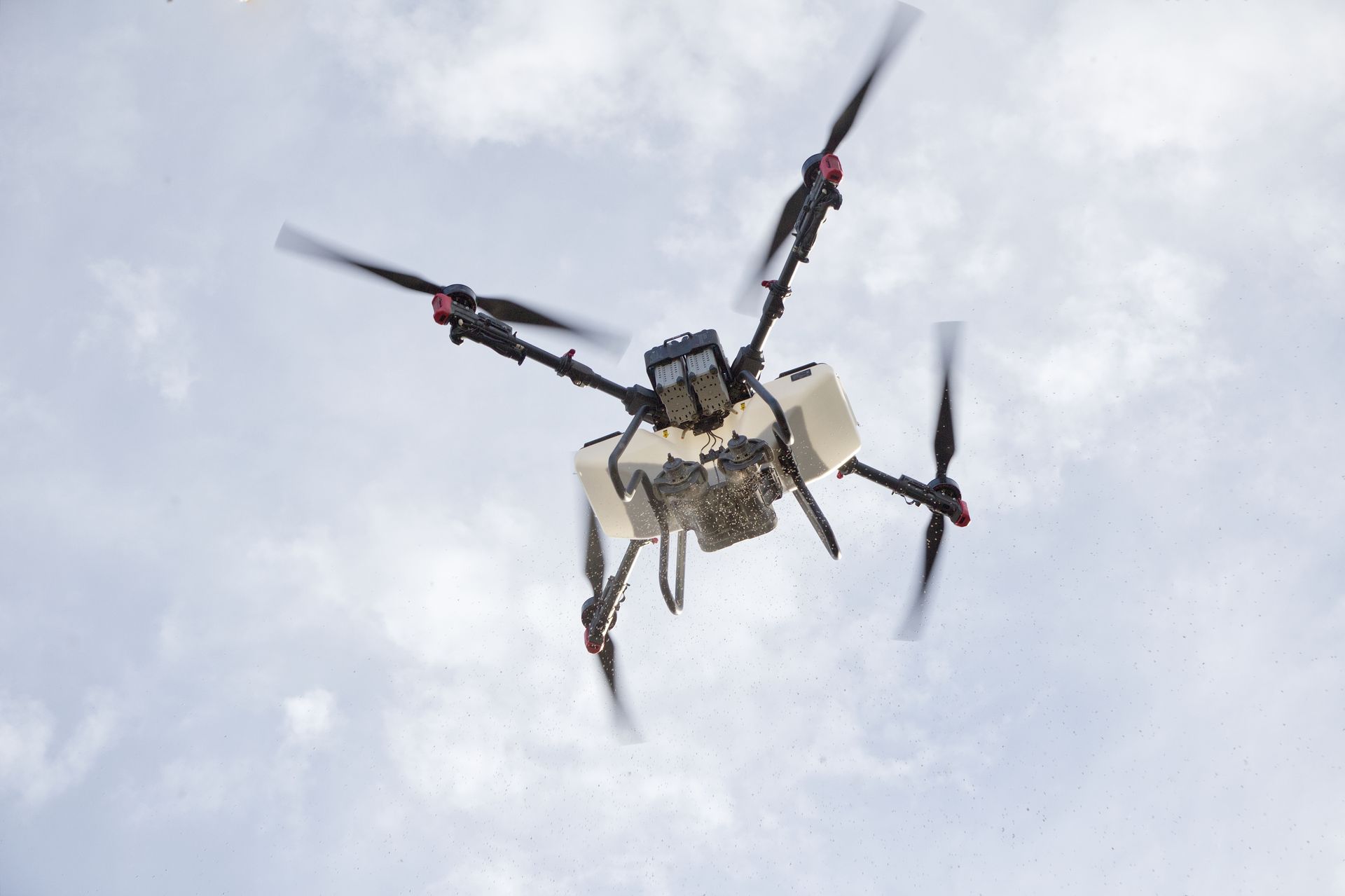
Aerovision Drone LLC offers broadcast seeding to help landowners regenerate pastures, restore disturbed ground, and seed reclamation sites quickly and accurately. Utilizing specialized drone-mounted seed spreaders, our broadcast seeding service covers uneven terrain and inaccessible areas with minimal soil disturbance and fast turnaround. Whether you’re re-establishing forage, rehabilitating erosion-prone ground, or seeding cover crops, drone-based broadcast seeding is an efficient tool in modern land management.
Why Broadcast Seeding Matters
Successful reestablishment of grasses, legumes, or cover crops often depends on timing, even distribution, and seed-to-soil contact. Conventional ground seeding can be expensive, time-consuming, and sometimes impossible on steep or rough terrain. Broadcast seeding from the air fills this niche by enabling:
Rapid, even distribution across varied terrain
Seeding in areas where tractors or ATVs cannot safely operate
Fast response to post-treatment windows following pasture spraying or controlled burns
Reduced soil disturbance, preserving existing root networks and structure
Key Benefits of Drone Broadcast Seeding
Speed
Cover acres quickly with repeated flights for large areas or multiple seed types.
Accessibility
Reach steep slopes, rugged gullies, and riparian edges without driving heavy equipment.
Gentle on Soil
Minimal compaction and surface disturbance help maintain soil structure and existing vegetation.
Targeted Distribution
Seed mixes can be applied to specific zones identified by prior mapping or scouting.
Synergy with Other Services
Combine seeding with pasture spraying to treat weed issues then reseed desirable species for faster recovery.
How Aerovision Drone LLC Implements Broadcast Seeding
Consultation and Seed Mix Design
Assessment: We assess soil conditions, erosion risk, existing vegetation, and grazing patterns to recommend seed varieties and mixtures.
Seed Selection: We advise on forage or cover crop mixes tailored for local climate, soil fertility, and management goals.
Timing: We select seeding windows based on moisture forecasts and expected germination conditions for highest establishment success.
Equipment and Calibration
Seed Hoppers: Drone-mounted spreaders sized to deliver predetermined seed volumes with consistent distribution patterns.
Distribution Patterns: Flight plans and hopper spread rates are calibrated to ensure the desired seeding rate per acre.
Quality Control: We conduct test dispersal runs to verify spread evenness before full-scale operations.
Execution and Follow-up
Pre-Flight Check: Confirm wind, moisture, and surface conditions are suitable for seeding.
Flight Execution: Execute planned passes to cover target areas, adjusting as needed for topography.
Post-Seeding Monitoring: Document application areas and provide follow-up monitoring recommendations including grazing rest periods or light harrowing if required for seed-to-soil contact.
Applications and Use Cases
Pasture Renovation: Reseed thin pastures after weed control to accelerate forage recovery and improve carrying capacity.
Erosion Control: Seed slopes and drainage channels with grasses and cover crops that stabilize soil.
Reclamation and Restoration: Seed disturbed land after construction or remediation activities with appropriate native species mixes.
Cover Crops: Apply cover crop seeds to improve soil organic matter, fix nitrogen, and reduce erosion in off-season periods.
Wildlife and Pollinator Plots: Seed native wildflower mixes or pollinator-friendly forage in targeted areas.
Environmental and Best Practice Considerations
Use of Native Species: Where appropriate, we favor native or regionally-adapted species to enhance biodiversity and ecological compatibility.
Avoiding Invasive Mixes: Seed mixes are vetted to avoid invasive species or aggressive cultivars that could outcompete native flora.
Soil Preparation: Minimal site preparation is preferred, but some situations require light soil disturbance to enhance germination — we provide guidance on best practices.
Why Aerovision Drone LLC is the Right Choice for Broadcast Seeding
We are committed to responsible pasture spraying practices:
Local Agronomic Knowledge: We design mixes and timing strategies tailored to Missouri’s climate and soils.
Precision Execution: We calibrate spreaders and flight paths to ensure consistent seeding rates and coverage.
Documentation: Post-operation maps and coverage logs help measure success and plan follow-up.
Integrated Services: Pair seeding with pasture spraying or mapping services for comprehensive land management.
Frequently Asked Questions — Broadcast Seeding
Will seeds establish without soil tillage?
Many forage and cover species will establish with minimal soil disturbance, especially when seeding is timed with adequate moisture. For heavily compacted or crusted soils, light surface preparation may increase success.
How Accurate is Seed Distribution?
Distribution accuracy depends on seed size, hopper calibration, drone altitude, and wind conditions. We perform pre-flight calibrations and adjust flight parameters to maximize evenness
Can you mix different seed sizes in one hopper?
Mixing seeds of different sizes leads to calibration complexities. We typically segregate seed types by flight or use carefully pre-mixed blends designed for aerial distribution.
What about seed cost and who provides the seed?
Seed can be supplied by the client or procured by Aerovision Drone LLC. We provide guidance on varieties, costs, and expected rates per acre.
book now
Contact Us
We will get back to you as soon as possible.
Please try again later.
Contact Us
To plan a broadcast seeding project, call (573) 578-5005 or visit us at 398 Route CC, Linn, MO 65051. We’ll evaluate your needs, recommend seed mixes, and create a seeding timeline to optimize establishment success.